Thursday, November 14, 2013

Top Ten Albums That Everyone Would Agree On.

Ignoring the fact that this list from NPR is all male (we can deal with that later) and is based on polls from their audience (probably a pretty old bunch of voters) what would you add to "albums everyone loves."
I would add Dave Brubeck's, TIME OUT and The Rolling Stones' EXILE ON MAIN STREET.
And I am not sure listeners under 35 would include so many Beatle albums. I think the "ear" has changed.
Top 10 Most-Loved (Ignoring Those Who Haven't Heard)
1. The Beatles: Revolver (92 percent love)
2. The Beatles: Abbey Road (91 percent)
3. Otis Redding: Otis Blue (90 percent)
4. Miles Davis: Kind Of Blue (89 percent)
5. Johnny Cash: Live At Folsom Prison (89 percent)
6. The Beatles: Rubber Soul (89 percent)
7. Bob Dylan: Highway 61 Revisited (88 percent)
8. Marvin Gaye: What's Going On (88 percent)
9. Sam Cooke: Portrait Of A Legend (88 percent)
10. The Beatles: The White Album (87 percent)
I can't help but think there won't be lists like this much longer. Not only has the vinyl record disappeared, but the idea of buying an entire CD is going away as we download a favorite tune or two. There was something magical about holding that album in your hand, reading the notes, and playing all of it--the good and the bad. So what if a couple of tunes were lesser works. It was the artist's statement at a particular time. Enough.
Wednesday, November 13, 2013
Whose Career Should Have Been Bigger?

Who else falls into this category?
Tuesday, November 12, 2013
Monday, November 11, 2013
Tuesday's Forgotten Movies

Richard Harris plays Frank Machin, a man who speaks with his fists all too often in this 1963 film by director, Lindsay Anderson. It takes place in northern England in all its grimy glory where Harris is recruited for a rugby team, a sport he seems perfectly suited to.
Rachel Roberts is the widow with two kids he becomes strangely infatuated with despite almost no encouragement from her. If you saw this film today, you would wonder if his interest was more in her kids, but not in 1963.
Harris is a bit too reminiscent of Brando in STREETCAR and Burton in LOOK BACK IN ANGER but he dominates the screen in his own right. Albert Finney was meant to play the part as he had starred with Roberts in SATURDAY NIGHT AND SUNDAY MORNING a few years earlier. But scheduling problems brought Harris on board.
Oddly, we see very little rugby. Perhaps it is not the most cinematic sport. Rachel Roberts does not garner much sympathy either. Did she ever? I wonder if another actress might have played her role very differently.
Where this film succeeded best for us was showing us northern England: the look of it, what people did for fun, how frugally most people lived there. It was beautifully put together.
We saw this film at the MOMA in New York. What a great program of films they have!
Has rugby ever figured into a crime fiction novel?


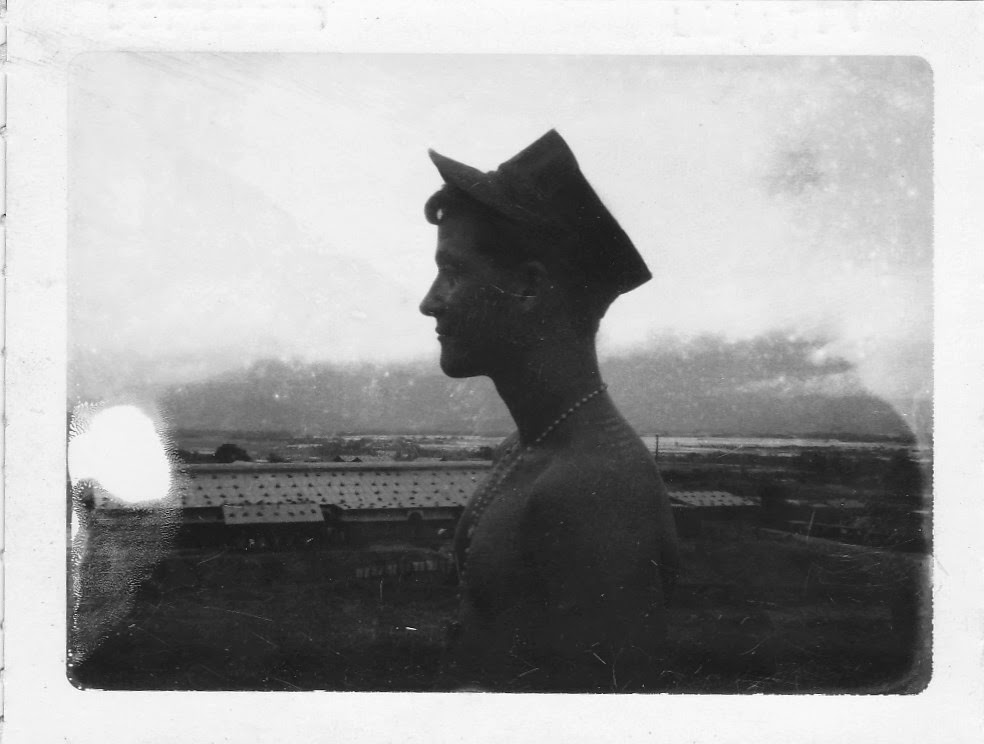
Veteran's Day


My Dad, Ralph Edward Nase, served in World War 2, drafted on the day of his marriage at age 27. He was in Europe for four years, landing at Normandy, he also served in the Battle of the Bulge. He never said a word about his war experience other than that the food was horrible.
Below the two pictures of my Dad is Phil at age one waiting for his father to come home on VJ Day. His Dad was in the Merchant Marines and spent most of the war at sea near Russia. We have no pictures of William Harvey Abbott in his uniform.
Phil's brother, William Edward Abbott (Billy), enlisted in the Marines at age nineteen, expecting to be a hero. He came home a year later with a Silver Star and three Purple Hearts. He never recovered from his war experiences, having spent his time in Da Nang as a point man. He could push on his legs and eject pieces of shrapnel. He was dead at 29.
 This is our family's experience with war. I hope no one is asked to die for such a thing again. It is far too much to expect of anyone.
Sunday, November 10, 2013
Saturday, November 09, 2013
How I Bailed on TWELVE YEARS A SLAVE...

But I thought this director was a more serious film-maker and would treat the subject with more respect and ground it in a more authentic story since it was based on a memoir. The Tarantino film seemed to engage in torture porn--if there is such a thing--and I was sure this one would be more rigorous in its approach
I lasted 50 minutes and then paced the lobby while Phil and our friend, Mel Small, a historian, finished the film. So I cannot review the film or even comment on its merits. What I did see did not seem particularly artful or less generic than the other films about slavery I have seen. The world is painted very much in black and white. And I don't mean that racially. Or perhaps I do.
Going into this film, my thought was if slaves could endure their treatment, I could manage to watch it. In a theater of all black patrons with the exception of us, I was the only one to walk out, making me a coward. When I mentioned this once to a black friend after Django, she said, "Well, we have lived with this story our whole life. Watching it affirms that it happened."
And I guess this is also why Jewish friends seem able to bear films about concentration camps more easily than I can. They feel none of the guilt (in both cases that I feel). I feel guilt at being a part of the group that allowed such things to happen.
Related to this, I will not see THE BOOK THIEF, which managed to convey the idea that a lot of Germans were as much a victim as the Jews in the book. I cannot go along with that idea because it is one step closer to denying the Holocaust for me. My book group loved the book but I found it turned the war into a fairy tale at points.
I am drifting all over the place here, but what I want to ask is what things would make you put a book down or walk out of a theater? I have walked out of only four films, I think, and all for different reasons. But this is probably the film I should have sat through. I will always feel like a coward for bailing on this one.
Friday, November 08, 2013
Friday's Forgotten Books: Ross Macdonald Day

Ross Macdonald was born Kenneth Millar in Canada in 1915. He was abandoned by his father at an early age, perhaps setting into motion the themes he would pursue in his stories.
He completed a Ph.D at the University of Michigan but ended up using his talents as a crime fiction writer rather than a scholar. His wife, Margaret Millar, a great talent in her own right, shares something with her husband beside a genre: both write psychologically attuned mysteries that examine the family in all its complexity. Few of their books do not delve into family secrets, grievances, ill-treatment. Macdonald's first novel was published in 1944.
He died in 1983, suffering from Alzheimers. The Millars had one daughter who they lost early on. A grandson died prematurely too.
Most critics regard Macdonald as one of the greatest practitioners of the craft and his hero, Lew Archer as one of the great detectives. Perhaps few characters have inhabited so many books and revealed so little of a personal nature. But he is the prism through which some of the most complex crime stories of the time passed. And he could sure solve a crime.

Strangers in Town: Three Newly-discovered Mysteries by
Ross Macdonald, edited by Tom Nolan
(Review by Deb)
(Review by Deb)
Containing three short stories (only one of which was
published in Macdonald’s lifetime), written in 1945, 1950, and 1955
respectively, Strangers in Town
displays some of the earliest themes, characterizations, plot twists, and
motifs that are found in Macdonald’s longer works. In each one of these stories, we see elements
emerge that will be explored more fully in future mysteries, including the development
of Macdonald’s series private investigator, Lew Archer.
The first story, Death
by Water, was published in 1945 in Ellery Queen’s Mystery Magazine under
Macdonald’s real name, Kenneth Millar.
Written while Millar was serving on a naval vessel in the Pacific
Theater of WWII, the story features Lew Archer prototype, p.i. Joe Rogers, who
is investigating the drowning death of a wealthy man. Was it just an unfortunate accident or was he
deliberately killed? And, if the latter,
who is the killer? The man’s younger,
wheelchair-bound wife has only a few months to live herself. The man’s stepson is on a navy ship (much
like Millar himself when he wrote this story) and therefore unable to have
committed the crime. How about the dead
man’s brother, who struggles to live on a limited income? And where was the wife’s personal nurse when
the death occurred? Millar manages to
pack a lot of suspects and motives into a few pages, but what I found most
interesting about the story was the reference to ALS (aka, Lou Gehrig’s
disease) just a few years after Gehrig himself succumbed to the condition.
Lew Archer appears in the next story, 1950’s Strangers in Town, where he is hired by
a woman to prove that her son did not kill a pretty, secretive young woman who
was renting a room in her house. Archer
has to travel to a dusty town in the California desert to investigate this
one. As in much of Macdonald’s longer
fiction, the small California community in which the story is set is a
character in itself. What I liked most
about the story was the sympathetic and dignified treatment of African-American
and Hispanic characters (the victim and the alleged killer are both black; the
attorney defending the young man is Mexican-American)—they are depicted neither
as caricatures nor noble stoics, but as fully-realized characters with the
standard human mix of decency, faults, and failings.
The final story in the collection is 1955’s The Angry Man which features several
frequent Macdonald themes: The
mentally-ill and the often callous treatment they receive from law enforcement
and society as a whole; wealthy but dysfunctional families; the lengths to
which people who have no money will go in order to get it; and the
juxtaposition of a character’s surface persona with their inward self. You can also see Macdonald working on the
technical problem of how to have a first-person, non-omniscient narrator receive
and communicate information without the story devolving into one long piece of
exposition (I think Macdonald handles this type of narrative extremely well in
both his short and long fiction). Neither
this story nor Strangers in Town was
published in Macdonald’s lifetime. He decision
not to publish these works was not because they did not measure up to his
standards but for quite the opposite reason:
He liked what he had written so much that he wanted to expand upon it
and develop the material into longer works.
As entertaining as these short stories are, I found the
most interesting thing about the book to be its long, informative introduction
written by Tom Nolan which quotes extensively from letters Millar/Macdonald
wrote to his wife (fellow novelist, Margaret Millar—herself an FFB honoree some
time ago) while he was serving in the Navy.
During long, occasionally dangerous, deployments, Millar was able to
read extensively from the ship’s library and continue to write fiction and
develop his ideas for writing first-person murder-mysteries narrated by the
hard-boiled but moral private investigator who ultimately became Lew Archer.
The Chill, Patti Abbott

I found reviewing this book exceedingly difficult. The plot is very complicated and stopping at a point where not too many reveals have been mentioned is nearly impossible. So I will err here on the side of telling too little rather than too much.
Archer is hired by the callow youth, Alex Kincaid, to find his new wife Dolly, who has suddenly disappeared. Archer takes the case when it is clear the police are uninterested and finds Dolly quickly, but of course complications arise.
A man from her past has shown up at their hotel. This and the death of her college advisor, Helen Haggerty, has sent her into flight. She claims, in fact, that she's caused Helen’s death. Archer puts Dolly into a rest home with a man who has treated her in the past for similar incidents. Kincaid hangs around to keep an eye on her.
It seems that Dolly is linked to a number of mysterious deaths over a long period. The dean of the college Dolly attends also figures into the story at multiple points. He is dominated by his mother although puts up less of a fuss than you might expect.
This is very much a story about family relationships and how children can be manipulated by adults. The past has the present in a stranglehold in this book. Try as they might, the characters in THE CHILL are helpless but to follow a path they sometimes had no hand in making. Although many characters in THE CHILL only appear on the page for a minute or two, they are each given the traits to be memorable. Archer himself is the least memorable and I think Macdonald planned it thusly.
My favorite line, and one that sums up much of the plot, is "I'm beginning to hate old women."
Ross Macdonald (Kenneth Millar), The Archer Files: The Complete Short Stories of Lew Archer, Private Investigator, Including Newly Discovered Case Notes (Crippen & Landru, 2007)
Ross Macdonald (Kenneth Millar), The Archer Files: The Complete Short Stories of Lew Archer, Private Investigator, Including Newly Discovered Case Notes (Crippen & Landru, 2007)

In 2007 Crippen & Landru topped that with the volume
at hand, which contains not only the stories from the previous book but those
from the earlier Archer collections, The Name is Archer (1955)
and Lew Archer, Private Investigator (1977), as well as 11
“case notes” that were ideas for possible future stories, written between 1953
and 1965. This time Nolan’s introduction is about the character, Lew
Archer.
Whether you are a long time fan or a neophyte to
Macdonald’s work, reading him for the first time, this is a book you need to
get, whether you regularly read short stories or not. It is great having
all of them together in one place and the book is highly recommended. I
don’t know if it is still in print but you should definitely check It out.
It is 350 pages of terrific reading.
One final bonus. The book has been designed to look
like a Bantam paperback of the 1960s by “Jeff Wong (after Mitch Hooks)” with a
portrait of the author.
The Zebra-Striped Hearse (1962)

Archer runs all over Southern California and travels as far south as Mexico and north to Lake Tahoe and the complicated plot takes many turns until you realize things are not nearly as simple as they first seem. The titular hearse of the title is not metaphoric, by the way, but an actual vehicle that plays a part in the solution. Macdonald fans probably read this one years ago but I didn't and I'm glad I corrected that oversight now.
both the above by Jeff Meyerson
Ross Macdonald Reviews
Sergio Angelini, THE DROWNING POOL and THE GALTON CASE
Books to the Ceiling, THE WAY SOME PEOPLE DIE
Brian Busby, I DIE SLOWLY
Bill Crider, THE DROWNING POOL
J. Escribano, THE MOVING TARGET
Curt Evans, THE BARBAROUS COAST
Ray Garraty, THE DROWNING POOL
Ed Gorman, THE ARCHER FILES
Bruce Grossman, THE BLUE HAMMER
George Kelley, THE FAR SIDE OF THE DOLLAR
Randy Johnson, THE FERGUSON AFFAIR
Nick Jones, THE UNDERGROUND MAN. BLACK MONEY (covers)
Laura Langer, THE IVORY GRIN
B.F. Lawson, THE ARCHER FILES
Evan Lewis, BLUE CITY
Steve Lewis, THE DROWNING POOL
Todd Mason, LEW ARCHER: PRIVATE INVESTIGATOR
Pageturners, THE GOODBYE LOOK
Richard Pangburn, THE THREE ROADS
James Reasoner, THE ARCHER FILES
Kelly Robinson, THE IMAGINARY BLONDE
Richard Robinson, THE ZEBRA-STRIPED HEARSE
Chris Routledge, THE WYCHERLY WOMAN
Michael Slind, FIND A VICTIM
Kerrie Smith, THE CHILL
Mary Ann Smyth, THE DOOMSTERS
Kevin Tipple/Patrick Ohl, THE DROWNING POOL
Prashant Trikannad,THE NAME IS LEW ARCHER
James Winter, SLEEPING BEAUTY
And elsewhere in blogdom
Yvette Banek, MURDER ON THE BLACKBOARD, Stuart Palmer
Joe Barone, A VIRGIN OF SMALL PLAINS, Nancy Pickard
Martin Edwards, DEATH HAS A PAST, Anita Boutell
Curt Evans, THE MARK OF CAIN, Carolyn Wells
Ed Gorman, EYE IN THE RING, Robert Randisi
Jerry House, INTO THE WILD BLUE YONDER: POGO, Walt Kelly
Margot Kinberg, A CARRION'S DEATH, Michael Stanley
J.F. Norris, MASTERS OF THE MACABRE, Rusell Thorndyke
Ron Scheer, THE CABIN BOOK, Charles Sealsfield
Prashant Trikannad, THREE YOUNG RANCH MEN, Captain Ralph Bonehill
TomCat, THE CASE OF THE FOUR FRIENDS, J.C. Masterman
Thursday, November 07, 2013
Wednesday, November 06, 2013
THUGLIT 8
Thanks to Todd Robinson for including my story "The Higher the Heels" in this volume. The first with a wraparound cover.


First Wednesday Book Review Club: LOTS OF CANDLES. PLENTY OF CAKE


What I had hoped to read was an insightful book on being a writer and/or on growing old. Not a fairly standard one on being a baby boom generation woman. So perhaps it is my fault for looking for a book she did not promise.
I also began to resent how determined she was to put a good face on everything--as if her readers would steer away from any really deep look at the problems of aging in the 21st century.
I have enjoyed several of Quindlen's novels but this book seemed specifically designed to appeal to please. Should the story of one's life be about that?
For more reviews, see Barrie Summy.
My first best friend

When I was five, a girl finally moved onto our street in Philadelphia. She had brown hair and gray eyes and was beautiful. She liked all the things I liked. People used to call us the Bobbsey Twins.
I bossed her around mercilessly. (She was tolerant of bossy friends)
Her mother served us pretzels and pepsi, which I found amazing. We made tents that went on for miles. Her mother had trunks full of costumes we liked to dress up in. We did all the things girly girls did in the fifties. She was good at the hula hoop and skating. I was good at hopscotch and jacks. We each had a Ginny doll. Hers was pristine. Mine was so messy it had to be replaced. We had sleepovers. We were brownies together. She was a Methodist. I was a Lutheran.
In sixth grade, we finally landed in the same classroom. Oddly, this was the beginning of the end because she had built up a group of classroom friends and so had I. It was hard to separate home from school. Doris got her attention at recess. Ruth had mine.
When we went off to junior high school, I found more new friends and so did she. I should have kept in touch with Sally Walton. I wonder where she is now. Happy and healty I hope.


Who was your first friend?
Such glamor inside our teensy row house. We are six.
The boy is my brother, Jeff. We are at the zoo and I remember this day.
Subscribe to:
Posts (Atom)