Thursday, May 19, 2011

HOW I CAME TO WRITE THIS BOOK" Sandy Balzo


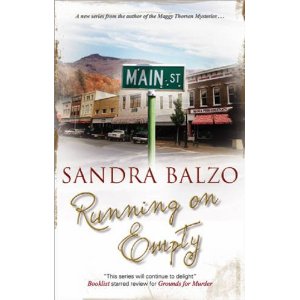
HOW I CAME TO WRITE THIS BOOK: RUNNING ON EMPTY

by Sandra Balzo

How did I come to write RUNNING ON EMPTY, the first novel in my new series, you ask?

Well, it's a funny story.

No, really--it is.

The year is 2005, and UNCOMMON GROUNDS, the debut book in what has become my Maggy Thorsen coffeehouse mysteries, has just been published. My literary agent is submitting the second book in the series, HASTA BARISTA, BABY, which was later published as GROUNDS FOR MURDER. Note: I like my title better.

Anyway, an editor who rejected that book loved the "cleverness, humor and irreverence" of my narrative voice. She thought I might be the perfect person to write a new series she had in mind. These mystery novels would be set in "small-town America," with a rotating cast of characters. Would I work up a synopsis and three sample chapters?

Given HASTA/GROUNDS hadn't as yet had a nibble, I thought this new project might be a very good thing to develop.

Starting point, the setting. In my mind, the perfect location could be summed up as "Cabot Cove meets Desperate Housewives, with maybe a splash of Jan Karon's Mitford."

Since I didn't think such a place existed in real life--at least without my being sued--I created a fictional lakeside town in Wisconsin and made it a tourist destination.

Why?

Because my destination angle solved the "fresh-meat" problem. For any mystery series within a contained setting, you need a logical reason that newcomers are drawn to town. Some decide to stay and become part of your continuing cast of characters. Others leave--be it vertically or horizontally. And sometimes take one or more of your regulars with them. But without this infusion of fresh blood (literally), sooner or later you run out of victims. Or, worse, tip your readers to the killer's target. Or worst, to the killer himself or herself.

The other reason I built in the regular influx of visitors was that I was--and remain--fascinated by the idea of a tiny town that swells to epic proportions during tourist season. I'd visited Laguna, California, a few months earlier to see clumps of people literally dancing in the streets. And in restaurants, art galleries, even on the beaches.

Again, why?

It was late in the year and not a holiday, so I asked one clump what was going on. They shouted--in unison, now, mind you--"The tourists are gone, the tourists are gone," the way the Munchkins sang "Ding-dong, the Wicked Witch is Dead."

I realized the locals were quite sincerely "reclaiming" their town, if only for a while. And, by the way they started eyeing me, I figured this outsider had best get out of Dodge while she still could.

When it came to the fictional blocks of my own mysterious "Main Street," I filled them with people and places that could have been there forever. Then I introduced a prodigal daughter into the mix. AnnaLise Griggs left town for college and had never returned. Instead, she became a police reporter in a big, Midwestern city.

Of course, in that first book, the prodigal daughter would be forced to return:

AnnaLise Griggs stood in a Wisconsin courthouse when she picked up, on the first ring of her cellphone, the call every adult child dreads.

“AnnaLise, this is Mama,” her mother’s oldest friend and owner of Mama Philomena's restaurant said. “You must come home. Your mother Daisy, she went and siphoned all the blood out of poor Mrs. Bradenham.”

Well, maybe not every adult child.

AnnaLise eventually learns that Daisy, a regular volunteer at the town's blood drive, properly clamped off the tube running from "poor" Mrs. Bradenham's arm after the woman had donated her pint. Unfortunately, Daisy then cut the tube above the clamp, resulting in an inadvertent bonus donation on Mrs. Murphy’s part.

When AnnaLise does arrive home, she finds the family's former food market has been turned into a club with a '50s beatnik vibe. Jazz, bongos, poetry. All night. And Daisy still lives in the owner's apartment above it.

AnnaLise also finds that “Mrs. Murphys’s bloodletting,” as the accident has been dubbed, has been accepted--like “mother blinded by wiffle-ball” and “fisherman squashed like nightcrawler,” before it--into the annals of local lore.

Until people start dying, and in even greater numbers than usual for this quirky little town.

In future books, Annalise will start a class in "Journaling and Memoirs" and thus be treated to a literary bird’s-eye-view of the goings-on (and associated "offings") through the journals of nearly everybody in town.

Clever, huh?

I sure thought so. The aforementioned editor, though, was less enchanted: "Love the characters, love the voice. Hate the concept."

Okay, I could have been petulant and pointed out it was her concept, at least at the core. Or, to be fair, maybe the seed. The book was set in small-town America, after all.

But I took the literary high road. I threw the synopsis and three sample chapters into a deep drawer, then slammed it shut.

Hard.

And I didn't look at it again.

Until . . .

Fast-forward four years. I now had five Maggy Thorsen books published, and I'm meeting with the editor who eventually bought that series. I mention the "Main Street" concept, and she bites. "Send me a synopsis and sample chapters."

Hey, I just happen to have those. Somewhere.

But yours truly is no longer living in Wisconsin. I'm now divorced and living in South Florida. My life has changed completely, and there's a whole lot of it still in boxes stuffed toward the back of a public-storage unit. Finding the particular one I dumped that drawer into is not going to be easy.

I never did unearth the paper hard-copy, but I did find the 3.25" floppy disk (remember those?) and a computer that--miraculously--still had a slot to insert the relic.

Since I already had a series set in Wisconsin, I decided to shift Main Street to "High Country," the mountains of western North Carolina. It was an area I'd visited and come to love, so I took a lake there, shoved it up against a mountain a few miles away and, voila, the fictional town of Sutherton, North Carolina, was born.

Scenic mountains, clear skies, fresh air and now twice as many fictional people to kill and be killed.

You see, High Country has two tourist seasons: Late spring through early autumn, when people like me flee the sweltering south for the coolness of higher elevations. And winter, when skiers arrive by the droves to ski down those elevations.

Which leaves just the month of November--unless, of course, the snows come early--for locals to enjoy their town in peace. When you get down to it, Suthertonians are not so different from their dancing counterparts in Laguna Beach. If, perhaps, more lethal.

I'll be returning to the real High Country in a few months, but, meanwhile, I hope you'll join me there for the first of the Main Street Mysteries, RUNNING ON EMPTY.

For now, though, I wish everybody a welcomed spring and a wonderful summer.

Sandy

www.SandraBalzo.com

PS: The first three books in my Maggy Thorsen coffeehouse series have just been released on Kindle. I've also "put up" there a new, original novel entitled HEAVEN’S FIRE, about a fireworks family and the explosion that nearly destroys it. Hope those of you who also "e-book" will try them out!

Sandra Balzo...

Sandra Balzo turned to mystery writing after twenty years in corporate public relations, event management and publicity. A CUP of JO, her sixth Maggy Thorsen coffeehouse mystery came out this past fall, and Sandy's second series, Main Street Mysteries, debuted in April with RUNNING ON EMPTY. The books, set in the popular vacation destination of North Carolina's High Country, will alternate with the Maggy Thorsen mysteries. HEAVEN'S FIRE, about a fireworks show gone badly wrong, was just released directly to Kindle.

Balzo's novels have been nominated for both the Anthony and Macavity awards and received starred reviews from Kirkus and Booklist. In addition to her books about coffee-maven Maggy Thorsen, Balzo writes short stories, two of which have been published in Ellery Queen Mystery Magazine, winning the Macavity, Derringer and Robert L. Fish awards.

Balzo has handled publicity for three Bouchercons (World Mystery Conventions), as well as the International Association of Crime Writers, and has served as a national board member of Mystery Writers of America.

Wednesday, May 18, 2011

Junket


I am wondering if this is a local (Philly) dessert from the 1950s because no one ever knows what I am talking about when I mention it. How about you guys? It was like a very light, milky pudding. Almost meringue like.

Did you eat desserts in childhood? What was your typical dessert? This may have been mine.

Acting


It has always fascinated me that some actors always play themselves (Cary Grant, Jennifer Aniston, Julia Roberts, Jack Lemmon, Jodi Foster, Tom Hanks, Vince Vaughn, Diane Keaton, Sandra Bullock) and others sink so deeply inside a role until you hardly know them (Chris Cooper, Kate Blanchett, Meryl Streep, Philip Seymour Hoffman, Robert Duvall, Gene Hackman, Dustin Hoffman, Daniel Day Lewis, Matt Damon, Sean Penn, Christian Bale, Tilda Swinton). Maybe this is what audiences want. Who do you want to see the expected performance from and who would you be shocked to recognize?

Tuesday, May 17, 2011

What is your favorite piece of architecture?


I just saw the new Frank Gehry building in New York in the NYT and I can't wait to see it in person. My favorite city for buildings though is Chicago. Have you ever done the architecture on the river tour?

I love the Gehry Guggenheim building in Balboa, but for sheer magic, it is hard to beat the Gaudi architecture in Barcelona.

Architecture always interests me because it can be so wrong or so right. This is the single instance Prince Charles made sense to me. When he decried the awful architecture of the seventies and eighties.

So what building do you like best?

What is your favorite building? If you notice them at all.

Monday, May 16, 2011

Sada Thompson: Best TV Mom Ever?


The Lawrence family, Nancy, Willie, Buddy and their parents Doug and Kate, were on TV in the late seventies and one of the first dramas to deal heavily with issues of the day. The character were flawed and struggled with societal mores of the time. But the love of parents for children, for siblings for each other always triumphed.

HOW I CAME TO WRITE THIS STORY: SANDRA SEAMANS


"HOW I CAME TO WRITE THIS STORY: Sandra Seamans

A while back Patti asked me if I’d like to contribute a piece to her series, “How I Came to Write This Story." I hesitated, mostly because it’s hard to explain how a story comes to be. The truth is, no two stories evolve in the same way, even from the same author. Every story has it’s own pattern. But Patti persisted and here I am staring at a blank page wondering what to say.

The story I chose to write about is “In God’s Own Time” published over at A Twist of Noir” last year ( http://a-twist-of-noir.blogspot.com/2010/09/twist-of-noir-583-sandra-seamans.html ) and one of my favorites from the last few years. It all started with this bit of dialogue that popped into my head one night.

“You know, I was seventeen and pregnant the afternoon my daddy died. I put a shotgun to his head and blew his brains all over the Lazy Boy. Hell of a mess that was. I was told they had to toss that old chair out in the trash cause there just wasn’t no cleaning the blood and brains out of the fabric. Pity, it was a nice chair.”

I wasn’t sure what to do with it but a post by Charles Gramlich on his Razored Zen blog felt like he’d tossed a glove down in front of my keyboard. Charles said he didn’t care for stories that started with dialogue and here I had this great opening for a story that was all dialogue.

Oh, I wrestled with several ideas, but nothing seemed to work because the character I was trying to write, I didn’t even like. I set the story aside until Spinetingler hosted a contest that wanted revenge stories, and even then I didn’t consider this story. I dug out an old story about a man getting out of prison and seeking revenge on the step-mother who put him there.

Of course, at the time, Dave Zeltserman had a series of men out of prison novels that everyone was talking about. I figured anything I wrote would never be as good as what he’d done, I’d just be treading plowed ground. Then I wondered what if it was a woman who got out of prison?

I pulled out that snippet of dialogue I’d written and changed the “I put a shotgun” to “somebody put a shotgun” and I had a woman who was looking for the person who killed her Daddy.

Then the questions began. Who’s she talking to? I stuck her in a pickup with a kid who knew her history but not who she was. I knew she was heading home but I wondered what happened to her baby? Who had framed her and why? And slowly the story unfolded. It went way too long for the contest, but I didn’t care. I was enjoying the journey this woman was taking to retrieve the twenty years she’d lost. What I loved most was it didn’t turn into the usual story of revenge at gunpoint. It became the story of a twisted obsession and the pressure of gossip in a small town.

You can find Sandra most days over at her blog, MY LITTLE CORNER. Her terrific stories are everywhere.

Sunday, May 15, 2011

WRITERS: DO YOU READ YOUR WORK ALOUD?


I do, but only inadvertently because that's the way my writing group works.

I read a blog post where Laura Lippman said she was about to begin reading her newest book aloud. I can't imagine doing that. My voice would never hold up and nor would my confidence.

What I would like is have someone else read it aloud to me.

I think I could really pick up flaws if I heard someone else read it aloud. Does anyone do this? I suppose I could record it and then listen but I hate my voice. (Philadelphia does not produce good reading voices).

DO YOU READ YOUR WORK ALOUD?

Saturday, May 14, 2011

"How I Came to Write This Book": Dave White


HOW I CAME TO WRITE THIS BOOK: Dave White: WITNESS TO DEATH.

It all started with James Bond.

I’m a huge James Bond fan. I’ve read all the Fleming novels—save THE SPY WHO LOVES ME, but including THE MAN WITH THE GOLDEN GUN—and seen all the movies multiple times. So much so that I can quote the really awful lines in MOONRAKER. My favorite is, “Mr. Bond, you appear with the tedious inevitability of an unloved season.” And it’s lines like that which inspired WITNESS TO DEATH.

In fact, I think the first tickle at the back of my brain came when I saw DIE ANOTHER DAY. The first hour of DAD is great. Dark, smarmy, action packed. The last half is… well, let’s not talk about it. And I thought—I want to do better. I want to write a James Bond novel.

So, I tried. Not to actually write a James Bond novel, there are way too many legal troubles or fan fiction stigmas that go along with that. But I tried to write a spy novel, one that had the fun and wit of a Bond movie. That roller coaster ride feel. Great stunts, hot girls, save the world at the last minute. You know the drill.

And it wouldn’t come.

I couldn’t get the feel right. Something was missing from the story. I put it away for a long time. And then I visited Washington DC for the first time ever. It was on my February break from school—I’m a teacher—and I was awed by the city. Loved the WWII Monument and the Lincoln Memorial. The grandness of it all, the majesty.

But it was the Spy Museum where it all started to come together. There are more spies in Washington DC then anywhere else in the world. And I started thinking… what if a teacher got mixed up in all that, somehow? What if a teacher got mixed up with a James Bond type?

And I had my story. There are some very Bond-eque ideas in the story. Bond always seems to move from a city, to a resort, to a desolate area. In my story, the characters end up in New York City, the Poconos, and New Jersey. There are ruthless killers, and beautiful women. Maybe even one in the same.

But it really isn’t a Bond story. It’s a thriller with moments I haven’t seen elsewhere. It’s got character, heart, and emotion.

But it all came from loving Bond. And memorizing a really bad line.

Dave White is the Derringer winning author of THE EVIL THAT MEN DO, WHEN ONE MAN DIES and a new collection, MORE SINNED AGAINST. You can find him at Do Some Damage.

Friday, May 13, 2011

The Summing Up, Friday, May 13, 2011


The Summing Up, Friday, May 13, 2011

Yvette Banek, The Bedside Bathtub and Armchair Companion to Agatha Christie, Dick Riley and Pam McAllister

Paul Bishop, Patterson's Volunteers, John Smith

Bill Crider, College for Sinners, Lawrence Block

Scott Cupp, The Helmsman, Bill Baldwin

Jerry House, THE MYSTERY COMPANION, edited by A. L. Furman.

Randy Johnson, Smoky Valley, Donald Hamilton

George Kelley, Three Entertainments, Graham Greene

Rob Kitchin, The Man Who Went Up in Smoke, Maj Sjowall and Per Wahloo

B.V. Lawson, I'll Sing You Two-O, Anthea Fraser

Todd Mason, Illustration, Jack Gaughan

J.P. Norris, Play to the End, Robert Goddard

Richard Pangborn, Eoin McNamee's RESURRECTION MAN

Eric Peterson, My Lovely Executioner, Peter Rabe

J. Kingston Pierce, The Kill, Douglas Heyes

David Rachels, Little Caesar, W.R. Burnett

Richard Robinson, Dead Man's Bones: The Air Adventures of Lester Dent, Lester Dent.

James Reasoner, Your Turn to Curtsy, My Turn to Bow, William Goldwin

Gerard Saylor, Running Blind, Lee Child

Ron Scheer, Best Western Stories 3, Max Brand

Kerrie Smith, B is for Burglar, Sue Grafton

Kevin Tipple/Barry Ergang, The Honest Dealer, Frank Gruber

Friday's Forgotten Books, May 13, 2011

Three on-blog posts got eaten but here are most of them. Blogger be good!


Yvette Banek
Paul Bishop
Bill Crider
Scott Cupp
Jerry House
Randy Johnson
George Kelley
Rob Kitchin
B.V. Lawson
Todd Mason
J. F. Norris
Richard Pangborn
Eric Peterson
James Reasoner
Richard Robinson
Ron Scheer
Kerrie Smith
Kevin Tipple

Steve Lewis/William F. Deeck
J. Kingston Pierce
David Rachels
Gerard Saylor

Thursday, May 12, 2011

My Life at the Theater

A Day at the Zoo.


For years I have been saving the programs from every play or musical we have attended. I could never think of a thing to do with them... until now. Believe it or not, I slept through most of this. We arrived in New York in a huge snowstorm and the warm theater at the end of a long day, did me in.
It was 1993 . Have you seen GUYS AND DOLLS?

HOW I CAME TO WRITE THIS BOOK, Rosemary Harris


How I Came to Write This Book

Anyone who's ever seen the movies Best in Show or Little Miss Sunshine know that shows and contests can get pretty cutthroat. And to an onlooker it can seem funny if the participants' struggles for perfection turn neurotic or obsessive. I take things one or two steps further in Slugfest, the fourth title in my Dirty Business mystery series and the action is set at a northeast flower show where more than just the plants are dying.

As a long-time volunteer at the legendary Philadelphia Flower Show I've had access to much behind-the-scenes information. I've seen the empty, airplane hangar-like convention center turn into a tropical paradise or an undersea garden in a matter of days. I've also seen some fairly hysterical behavior similar to that seen in the two movies I mentioned. Not wanting to incriminate or kill off any of my pals at the Philly Flower Show I created the fictional Big Apple Flower Show where there are so many mishaps exhibitors are starting to jokingly refer to it as the Javits Curse, but the laughter stops when one body is found at the foot of an unused escalator and another floating in the river. My amateur sleuth Paula Holliday accidentally holds a crucial clue to solving both murders and another, if she doesn't figure out who's taken off the gardening gloves and turned this genteel flower show into a slugfest.

Writers of traditional mysteries are frequently asked how they can marry humor with murder - after all, real crime isn't funny. It isn't. But people are. And they don't stop being who they are when bad things happen. (I swiped that line from none other than Carolyn Hart, who knows a thing or two about writing mysteries.) Even the most notorious villains in literature have delivered zingers. Think of Hannibal Lecter's "I ate his liver with some fava beans and a nice Chianti." How much less chilling would it have been if he'd just said "I ate his liver"? Black humor to be sure, but still very funny.

There are no Hannibals and no cannibals in the Dirty Business books just an amateur sleuth drawn into sometimes challenging and dangerous situations armed with nothing more than her smarts, her sense of humor and the occasional power tool.

Rosemary Harris' debut novel Pushing Up Daisies was nominated for both the Anthony and the Agatha Award for Best First Novel 2008. Others in the series are The Big Dirt Nap, Dead Head and Slugfest (April 2011.) They've been called "a wild and funny ride" Crimespree Magazine, "hilarious" Kirkus Reviews and " the perfect summer read" NPR (CT.)

Visit Rosemary on facebook and at www.rosemaryharris.com

Wednesday, May 11, 2011

A WIDOW'S STORY


I thought this was a very interesting book for a lot of reasons, one of them being that JCO never really mentioned the fact that she had remarried by the time she was done writing the book. A review of it in THE NEW YORK REVIEW OF BOOKS took her to task a bit for this and in today's issue, she responded. She admitted she should probably have included that information in an afterword, but also said that it didn't change the experience of grieving for her husband.

She compared it to a memoir about cancer. If the writer recovers does it make his/her experience less valid.

Does she have to continue to grieve for us to give credence to this book?

Where does the story end--I guess that's the question? Does her happiness now make her unhappiness after her husband's death then a lesser one than someone who never married again?

THE END OF EVERYTHING


Sometimes it gives me the shivers that she can write like this.

This is the first book set in the place we live. In the time she was that age. Was it really like this? Southeast Michigan in the eighties was more sinister than I ever realized apparently.

Does it surprise you when your memories of a time are so different from your child's? Or your parents? Or spouse?

Tuesday, May 10, 2011

Tuesday Night Music: Kris Kristofferson

Forgotten Movies: ALICE DOESN'T LIVE HERE ANYMORE


I came upon this scene from ALICE DOESN'T LIVE HERE ANYMORE on TCM the other day and realized how much about this film directed by Scorsese in the seventies I'd forgotten. I'd forgotten the naturalistic performances that movies from the era had. I'd forgotten what real settings can do for a film.

When Alice Hyatt (Ellen Burstyn) is suddenly widowed, she travels to California with her 11-year-old son Tommy (Alfred Lutter) to resurrect a singing career. In route in Phoenix, she gets a job singing at a piano bar and meets us with Ben, (Harvey Keitel) who turns out to be married and abusive. In Tucson, she puts her dream of singing on hold and becomes a waitress. She meets a farmer, David (Kris Kristofferson) and begins to think about a new life with him.

In an interview with Richard Schickel, Scorsese said it was really about a woman and her son and those scenes are the strongest in the movie. He says, "It was not for the feminists. They felt that because she got involved with another man, it undercut the independence of the woman...but that's the movie I made."

I remember the same issues being raised with AN UNMARRIED WOMAN. Both great films.
If you've never seen this one, you are in for a treat. We allow a little more latitude in what constitutes feminism now. For better or for worse.

FOR MORE FORGOTTEN MOVIES, GO TO TODD MASON'S BLOG.

Monday, May 09, 2011

Give me a first sentence


It's happened. I cannot think of a story to write. Throw some first sentences at me and maybe one of them will click.

What Else? Stagger Lee

"HOW I CAME TO WRITE THIS STORY" Matthew C. Funk


HOW I CAME TO WRITE THIS STORY

by Matthew C. Funk

Unlike many of my characters, Stagger Lee didn’t sneak into my stories. He was no crossbreed of literary theme and plot device. He shouldered open the door and just started talking in an outdoor voice. Reality has a way of doing that.

I’ve never met Stagger, but the other day he called my friend. On account of her sleeping late, he left a message:

“If you’re working on your beauty sleep,” rushed the gravely bluegrass voice, “it ain’t happenin’. Call me.”

Half of the swaggering, country boy outlaw that roams my Stagger Lee stories is just an homage to the legend of the blues song—a tall tale figure fueled by impulse and driven by cunning that, in New Orleans fashion, I slipped across racial lines from black to white when I placed him in my favorite city.

The other half of my Stagger Lee actually filled those boots and walked that tall. The more felonious of Stagger’s stories are just drama of my own warped invention, but many of them were lived and suffered and laughed over by a real dude. I get them secondhand and decades old from our mutual friend, but they burn so damn bright I have to give them their due and brand a blank page with them.

Stagger Lee is the soul of the South for me, and that soul lives in a flesh-and-blood fellow. We’ll call him Davey. But make no mistake—though he may not share a name with the original African-American folk anti-hero, he’s a legend to his friends.

My Stagger Lee gets his background from Davey in many ways.

Davey floated between the upper-crust, white-tie world of the Kentucky Derby’s box-seat set and the underworld of East Kentucky good old boys who buried bullion in the acreage of their hillside shacks. He dined with pink-tanned golfers at the Lexington Club one evening and laid traps in his farmhouse the next. He outfoxed, out-charmed and outran the law on many occasions and never was turned away from a party with sterling silver settings on the table.

I also got a fistful of Stagger Lee’s stories from Davey. Stagger’s bravado in the face of danger comes from Davey’s easy bravery in the face of angry, gun-toting hillbillies. Stagger’s outsized generosity—like in my upcoming novel, City of NO, when he bought up scores of sets of silverware for his friends in Jamaica because he’d heard they had a shortage down there—is inspired by Davey’s actual purchases. Davey threw the first punch for the sake of his friends, Davey fell prey to painful pratfalls with the same devil-may-care attitude and Davey partied like he was in a drinking contest with the Gods.

That’s all pure Stagger Lee, because to me, it’s pure southern—a stretch of country that still lives as if thought comes from flesh, not from high ideals or dusty pages.

I invent a lot based on this schematic of the southern spirit. Davey walked too tall to be confined to one group of people, but Stagger breaks the bounds of reason and decency like the song that inspired his name. Where Davey would swing a fist, Stagger would pull a gun. While Davey kicked back with a questionable element, Stagger thrives as its beating heart. Davey may have skirted the law, but Stagger lives at war with it.

My Stagger Lee, as my newly completed rough manuscript about him defines, is the model of the ancient hero in modern cast—the hero that endures and inflicts terrific suffering solely for his own ends—the original hero of human kind, the outlaw hero. Davey is the outlaw spirit, the outlaw voice, the source of wit and wild tales that his friends still can’t keep bridled in and have to let gallop out of them.

In many cases, I’m sad to know my stories come from real people and real events. It’s a sense of duty to cast some light on where they’re suffering out of sight that compels me. In the case of Stagger Lee, I have a story that makes me smile almost every time.

Part of my joy is the appeal of Stagger Lee as an unchained ego. Call him Stagger or Hercules or Peter Pan, the outlaw superman draws us in because there’s an adolescent in us that never grew up—that still wants to kick down doors and knock about the china shop of civil society, breaking speed limits and sacred cows.

The other part of my joy comes of knowing that such a man lived so wild and came out of it with a smile on his face too.

It lets me rest easier under the mire of routine and hypocrisy and materialism to know that those constraints are just as mythical as Stagger Lee—that a dude can go through his entire adult life without working a day and still end up richer in a way than the rats in their race.

I’m glad Stagger Lee is alive in Davey. It reminds me that there’s a whole lot more to being alive than making a living.

Legends are true. Some of us come alive through them. Some bring them to life.

Matthew C. Funk won the 2011 Spinetingler Award for Best Short Story on the Web. TIMES PAST was featured at Alec Cizak's top All Due Respect.


Sunday, May 08, 2011

A Palate Cleanser: Who are the Worst Mothers in Literature


Well sure Medea and Gertrude come to mind. But in the books, we actually read, who scares you most? How about Mrs. White, Carrie's mother? Stephen King is hard to top in creating monsters.

Happy Mother's Day


I confess I was going to write a tribute to my Mom today, but it just felt too personal for such a private person. So instead, for those who stop by, what is/was your Mom's favorite reading material.

My mother adored Janet Evanovich, Maeve Binchey and Stuart Woods. So I salute those writers today. What about you?

Saturday, May 07, 2011

Historical Fiction


I just finished THE PARIS WIFE and it just didn't work for me. Much like LOVING FRANK didn't work a few years ago. I feel very uneasy about a book centered on imagined conversations between real people.

I think I have talked about this before. I don't mind "real" people in the background such as with works by Doctorow, but when the entire work is about two "real" people and all their "real" friends, I am uneasy. Certainly the portraits of characters like Fitzgerald and Zelda are stereotypical in this book as is the one of Gertrude Stein. Maybe the Fitzgeralds were always drunk and Stein always judgmental and imperious, but geez.

The author is creating a voice for her protagonist and it may very well be inauthentic. Perhaps Ernest was not the shit this book made him out to be and perhaps Hadley was more interesting or even troublesome than this book painted her. You could feel the author paging through other books to find where the couple went next, who they met and what happened. It never felt organic the way a good novel should feel. It felt like research disguised as fiction.

I am sure there is a book like this that did it better. Have any such books worked for you?

Friday, May 06, 2011

THE SUMMING UP, Friday, May 6, 2011


The Salk Institute in La Jolla

Check out my review of OF GODS AND MEN at Crimespree Magazine.


THE SUMMING UP, Friday, May 6, 2011

Patti Abbott, A Judgement in Stone, Ruth Rendell
Yvette Banek, Shakespeare's Landlord, Charlaine Harris
Paul Bishop, The XYY Man, Kenneth Royce
Michael Carlson, The Poison Sky, John Shannon
Bill Crider, The Kiss-Off, Douglas Heyes
Scott Cupp, Pogo Revisited, Walt Kelly
Martin Edwards, The Dangerfield Talisman, J.J. Connington
Elizabeth Foxwell, Murder in the Mist, Zelda Popkin
Ed Gorman, What Made Sammy Run, Budd Schulberg
Jerry House, Ossian's Ride, Fred Hoyle
Randy Johnson, The Perfect Frame, William Ard
George Kelley, The Universe Wreckers, Edmond Hamilton
B.V. Lawson, The Grand Babylon, Arnold Bennett
Evan Lewis, Two-Gun Gerta, C.C. Waddell and Caroll John Daly
Steve Lewis and Allen Hubin, Death of a Hollow Man, Caroline Graham
Todd Mason, The Female Man, Joanna Russ
J.F. Norris, The Strange Papers of Dr. Blayne, Edward Heron Allen
Richard Pangborn, Crazy Over Horses, Sam Toperoff
David Rachels, The Black Mask Boys: Masters of the Hard-Boiled School of Detective Fiction
James Reasoner, Shadow at Noon, Harry White (Harry Whittington)
Richard Robinson, The Shell Seekers, Rosamunde Pilcher
Gerard Saylor, First Wave, James R. Benn
Ron Scheer, Friar Tuck, Robert Alexander
Kerrie Smith, Guardian Angel, Sara Paretsky
Kevin Tipple, Hardboiled Hardcore, Todd Robinson

Friday's Forgotten Book, May 6, 2011

I will be back later in the day to add any other posts. At 8:46 AM these were the post up.


Ed Gorman is the author of TICKET TO RIDE and STRANGLEHOLD. You can find him here.

I was fourteen when I read What Makes Sammy Run. I bought it off the same wire rack where I bought some of my science fiction and mysteries. The back cover copy interested me enough to open the book. I liked the smooth realistic style of the book so much I finished it by the time I went to bed that night.

Budd Schulberg's take on American Success stories is more relevant than ever.

Wikipedia:

"Told in first person narrative by Al Manheim, drama critic of The New York Record, this is the tale of Sammy Glick, a young uneducated boy who rises from copy boy to the top of the screenwriting profession in 1930s Hollywood by backstabbing others.

Manheim recalls how he first met the 16-year-old Sammy Glick when Sammy was working as a copy boy at Manheim's newspaper. Both awed and disturbed by Sammy's aggressive personality, Manheim becomes Sammy's primary observer, mentor and, as Sammy asserts numerous times, his best friend.

Tasked with taking Manheim's column down to the printing room, one day Glick rewrites Manheim's column, impressing the managing editor and gaining a column of his own. Later he steals a piece by an aspiring young writer, Julian Blumberg, sending it under his own name to the famous Hollywood talent agent Myron Selznick. Glick sells the piece, "Girl Steals Boy", for $10,000 and leaves the paper to go to work in Hollywood, leaving behind his girlfriend, Rosalie Goldbaum. When the film of Girl Steals Boy opens, Sammy is credited for "original screenplay" and Blumberg is not acknowledged.

Glick rises to the top in Hollywood over the succeeding years, paying Blumberg a small salary under the table to be his ghost writer. "

Ed here: Glick reminds me of so many CEOs on Wall Street. They ride a rigged system that allows them to preen and pose and steal. They produce nothing. And what Glick does to poor Julian Bloomberg is exactly what Wall Street has done to us.

Budd Schulberg is above all a great reporter as well as a great storyteller. Mannheim shows us the Hollywood of that era from the from offices that are run like war rooms to the constant attempts by the studio magnates to break writers every way they can to the ridiculously glitzy parties. The people we like in Sammy--and there are a lot of them; generally the people who do the actual work--are rarely invited to the splashy parties of course.

Just as Billy Wilder was attacked by studio heads for writing producing Sunset Boulevard, so was Schulberg attacked for Sammy.

From American Legends:

"When published in 1941, What Makes Sammy Run? was a best seller and was praised by Scott Fitzgerald, John O'Hara, and Dorothy Parker who said the book captured the "shittiness" of the film business.

Sammy hit Hollywood like a firestorm. Louis B. Mayer attacked the novel publically and privately and vowed to run Schulberg out of town. He almost succeeded. Budd was fired from the Samuel Goldwyn Studios where he was then working, and it was several years before he landed another screenwriting job.

Some critics feared that the book would contribute to the anti-Semitic stereotype of the Hollywood mogul or provide ammo to those who were persecuting the Jews of Europe.

Schulberg strongly objected to this criticism. To him, Sammy represented the dark side of the Horatio Alger legend: someone who was an "all- American heel," regardless of religion.

Indeed, Sammy himself was areligious, as well as apolitical and amoral. When a company informed him that it was not hiring "Hebes," without missing a beat, Sammy passed himself off as an Italian- American."

Ed here: Schulberg is especially good writing about women and the book boasts at least three fascinating females who offer interesting takes on all the would-be macho business games the men play.

To me this is one of the most vital novels of its era. It certainly spawned hundreds of imitators; none ever as good. And it shows how eloquent the American tongue was when used skillfully. As Mark Twain said write the way you talk and Schulberg certainly does that here.

Patti Abbott, A JUDGEMENT IN STONE, Ruth Rendell

I have read almost all of Ruth Rendell's books. She has been mentioned here very little, a surprise to me. Because between the Wexford series, the Rendell standalones and the books written as Barbara Vine, she has pretty much covered all the bases in crime fiction. Her short stories are to be savored also.

One of my favorites is A JUDGEMENT IN STONE which begins like this:

Eunice Parchman killed the Coverdale family because she could not read or write. There was no real motive and no premeditation; no money was gained and no security. As a result of her crime, Eunice Parchman's disability was made known not to a mere family or a handful of villagers but to the whole country. She accomplished nothing by it but disaster for herself, and all along, somewhere in her strange mind, she knew she would accomplish nothing. And yet, although her companion and partner was mad, Eunice was not. She had the awful practical sanity of the atavistic ape disguised as twentieth-century woman."

This description of the price of illiteracy could also apply to the more recently published book THE READER. But Rendell did it first. Two movies have been made of this novel. The more recent Chabrol adaptation (Ceremonie) was riveting.

While we are repulsed by the behavior of the housekeeper, Eunice Parchman, we also understand and pity her. Who can ask more?

Yvette Banek
Joe Barone
Paul Bishop
Michael Carlson
Bill Crider
Scott Cupp
Martin Edwards
Elizabeth Foxwell
Jerry House
Randy Johnson
George Kelley
B.V. Lawson
Evan Lewis
Steve Lewis/Allen Hubin
Todd Mason
J. F. Norris
Richard Pangborn
David Rachels
James Reasoner
Richard Robinson
Gerard Saylor
Ron Scheer
Kerrie Smith
Kevin Tipple

Thursday, May 05, 2011

An Unexpectedly Good Movie: BIG FAN

BIG FAN: 2009

I doubt many of you have seen this little film starring Patton Oswalt and Kevin Corrigan. I don't know how I first heard of it and I was dubious to say the least since I am far from a football fan.

But this was a little gem. Patton Oswalt plays a parking garage attendant whose whole life (he still lives with his mother) is built around his love of the New York Giants. When he has an altercation with his favorite player, his love is tested. A life that might depress most people is prized by this character.

This is a surprising and insightful film that I highly recommend.

What movie did you watch reluctantly and come to admire? Fill up my netflix queue.

Wednesday, May 04, 2011

First Wednesday Book Review, Emily Alone, Stewart O'Nan

FOR A FASCINATING PIECE ABOUT LA NOIRE, the new game and anthology, go here.
******************************************************************************
I am a huge Stewart O'Nan fan and this book certainly lived up to my expectations. It is probably not for everyone though. It is the story of an elderly widow and a few rather lonely months in her life. It reminded me of MRS. BRIDGE for those who remember that wonderful novel.
Emily buries friends, entertains her family, frets about perceived slights, remembers both happier and unhappier times, cares for her dog, spends time with her cleaning woman and sister-in-law. Worries about her children.

And yet these small events add up to a life. Never for a moment do you doubt Emily exists as an elderly woman, quite aware of what lies ahead. She is neither better nor worse than the rest of us. O'Nan captures her so perfectly you forget for long periods that a man is inside her head.

To write like him....

For more review, visit Barrie Summy.

Tuesday, May 03, 2011

Tuesday Night Music; TREME


Way into TREME again.

Jim Belushi: An Actor for Our Times?


James Belushi has surprised me. I've thought of him as building a career on his brother, John's, coat sleeves. Capitalizing on a superior talent he's laid claim to somehow. IMHO.

But I have to admit with a TV series (THE DEFENDERS) and a play on Broadway, where he has had good reviews (BORN YESTERDAY), that he has had a very good career in his own right. People must see something in him that I don't. To me he is the pale imitation. A thuggy obnoxious kind of pretender. I just don't get it.

But that's just me. Whose career has surprised you. Who did better than you thought their talent merited?

Monday, May 02, 2011

Home Again. Home Again, Jiggedy Jig


We were at the Pentagon Memorial a few hours before the announcement of Bin Laden's death yesterday. This sort of eerie coincidence happens all too often, doesn't it? Two days earlier, I gave an aqua dragonfly broach to friend who turned out to be making a quilt with a dragonfly in aqua. Key in TWILIGHT ZONE music.

I have very ambivalent feelings about celebrating Bin Laden's death today, although I have no ambivalence over my relief in the death itself. He was a monster and deserved his fate tenfold. The number of deaths that have emanated from that day's deeds is incalculable.

Standing at this memorial a few hours earlier in a gray drizzle: a place so quiet, moving and evocative of the airplane that crashed into the building, I was immediately taken back to that horrible day--one I will not forget, one that felt unreal, impossible. Not us! We do not get attacked, do we?

For those who have not seen this memorial, there is a bench for every victim that died on the Pentagon site on Sept. 11. 2001 (184), arranged by age of the person. Some of the benches, all which resemble airplane wings (to me), face in one direction (people on the flight), and the other benches (people inside the Pentagon) face the other. The Pentagon rising in front of the memorial has the same plain sad look. It is austere, quiet, pristine. It is concrete, gravel, gray.

But back to the news that came later, it is very hard for me to celebrate a death. It is easier for me to mourn a life so misspent, a life overtaken by the mistaken notion that killing innocent people could ever be just. That violence begets anything positive.

Does this make sense? Are you completely jubilant over the death of a man? Even this one?

"HOW I CAME TO WRITE THIS STORY" : Steve Weddle


"Nothing Personal" Steve Weddle

I’d been consumed with this Alex Jackson novel. He hates guns, loves his mother, and has had a crush on a woman since they were in high school fifteen years before.

When a couple of guys with guns threaten Alex and his mom, Alex throws up on the guys. A hundred pages later, when Alex and a friend of his are running from another gun-toting bad guy, Alex gets shot in the butt and passes out. A hundred pages after that, Alex and the big bad guy face off, which doesn’t work out so well for Alex.

Fun times and all, but I had a real need for a thick porterhouse to balance out the steady diet of chicken salad.

And Oscar Martello was born.

On night, I was standing in the library of the Weddle cabin looking across the front yard, wondering about the movement I’d just seen. Probably nothing, of course, but I reached behind one of the top shelves – the one with Ted Kooser, Stephen Dunn, Anne Sexton, and Andrew Hudgins – and pulled out the knuckledusters. I stood at the window, lights out, holding a tumbler of Jack Daniel’s in one hand and testing the weight of the knucks in the other.

I thought of smashing the glass and spreading the shards near the door so I could hear the person once they’d broken in. I thought of setting something up on one side of the hall to draw attention while I waited on the other side. Knee-level. Temple-level. Preparing for the assault.

I made some notes before I fell asleep and started sketching out the story in the morning.

One guy breaking into our home might be enough to cause me some trouble, but I needed a real tough guy. So I wrote the story of three guys breaking into the home of a bad-ass. And I needed to know why. And I wanted it to be a betrayal, maybe the breaking of a mentor-mentee relationship. Or maybe it could be the betrayal of a lover. So I had the mentee breaking into the mentor’s house. And then I played around with the lover’s betrayal. One saying the other had betrayed Oscar Martello.

I wanted Oscar to doubt the relationship with both, to wonder which one had turned on him. I wrote the story, leaving one at fault. Tough guy. Guns. Tight. Some nasty fighting. I sent it off to Plots With Gun. They turned it down without much hesitation, saying simply that it didn’t quite work.

Well, crap.

So I reworked it along with the beginning of another Oscar Martello story. I started to get a better feel for the character. I had an image of Luca Brasi, wanting to get out of the business of killing people. The break-in story, “Nothing Personal,” became more layered, more nuanced. A much better story than I’d sent to PWG.

I sent the revision off to fantastic Crimefactory and it appeared in their first rebooted issue, right around the time the second Oscar Martello story I’d written, “Missed Flight,” appeared at the amazing Beat To A Pulp.

What I haven’t mentioned is that all the while I’m playing with these stories, I’m sending parts and ideas to every friend who will return an email. Does this work? Is this too over-the-top? Can you picture this?

And I’m going back into the stories many times over.

Raymond Carver said that he wrote short stories instead of novels because he could get a story done in one sitting, maybe two, so it felt like a better accomplishment. He was always quick to add that he’d spent a long time revising those stories, adding and taking away.

How did I come to write Oscar Martello’s stories?

One night, the idea broke into my house. Then for months and months, I held the idea down and beat the holy hell out of it.