Showing posts sorted by relevance for query speak low. Sort by date Show all posts
Showing posts sorted by relevance for query speak low. Sort by date Show all posts
Monday, September 07, 2015

Thursday, September 10, 2015
Sunday, September 06, 2015
Tuesday, September 08, 2015
Wednesday, September 09, 2015
Sunday, January 19, 2014
Monday, April 08, 2013
Five Years of Forgotten Books, Day 8


Timothy Hallinan, Christopher West Series

West Meets East
As someone who writes mystery/thrillers set in Asia, I keep an eye on the competition. And I'd be lying if I said that I greet with unreserved enthusiasm the publication of a novel by a writer who intends to take a bite out of what I think of, in my less generous moments, as my fictional territory.
So I'm in an awkward position when it comes to Christopher West. West's four novels about police inspector Wang, set in Beijing, are definitely competition – or they would be, if they were still in print and West had a new one coming out. But they're not, and he doesn't, and that's a terrible shame. West is a wonderful writer and he deserves a broad and appreciative audience.
The book that begins the series, Death of a Blue Lantern, is a great place to start. Attending a performance of the Beijing Opera, Wang takes his time leaving the theater, and on his way out he notices a patron who seems to be drunk or unconscious. He's not, of course; he'd dead, dispatched with a tidy knife wound to the back of the neck, destroying the medulla oblongata. The victim proves to be a “blue lantern,” or low-level Triad recruit, and Wang's investigation quickly leads him to the Triad's “Red Cudgel,” or enforcer – and his beautiful daughter, who sings in a foreigners-only nightclub atop one of Beijing's most expensive hotels.
The plot ultimately also involves an archaeological site where precious works of art are being stolen, and a broad and varied cast of characters, almost any of whom might be the person Inspector Wang seeks. It's a great plot, intricate and beautifully structured, but the two most beguiling things about the book (and the rest of the series) are the characters and the setting.
The characters, beginning with Wang himself are nuanced individuals, real people whose differences make them easy to keep track of despite the unfamiliarity of Chinese names, which can be difficult for Western readers to remember. There isn't a flat sketch in the bunch: they all seem much deeper than the printed page.
The setting is riveting, not just because it's China, but because it's China at a specific moment, poised at the opening movement, so to speak of Deng Xiaoping's Communism-shattering economic liberalization, but not far removed from the brutal crushing of the protesters at Tiananmen Square in 1989. Death of a Blue Lantern was written in 1994 and is probably set a year or two earlier. The Party, now widely ignored in China, still inspires (in the novel) a certain amount of dread; West's Beijing is full of people who have come from the countryside, but they are just a trickle compared to the hordes – the largest human migration in history – who have trekked from village to city in the past five or six years. Private businesses have sprung up, but there is not yet the preoccupation with becoming rich, nor is there the vast gulf between the have-alls and the have-nothings that scars present-day China. Some of the book's action takes place in the alleys and hutongs of old Beijing, the vast majority of which have now been swept aside, thousands of them destroyed for the Olympics.
Inspector Wang is a good man who believes in justice, and who is caught up in a system that is changing so fast that it threatens much of what he and those around him believe in. Matters of life and death, guilt and innocence, are immutable, but in West's novel, those issues are confronted in a world where virtually nothing else seems to be permanent. The China in these books is on the brink of the most profound short-term transformation of any nation in history.
Read Death of a Red Lantern. Read everything by Christopher West. He hasn't published a novel (to my knowledge) since The Third Messiah in 2000. If enough of us order his books, maybe some publisher will see what a writer of Christopher West's talent could do with the China of today, the China we all watched, openmouthed, for fourteen days in August.
Wednesday, February 28, 2024
Short Story Wednesday: "My Cheesecake-Shaped Poverty" Haroki Murakami

https://www.newyorker.com/books/flash-fiction/my-cheesecake-shaped-poverty-haruki-murakami
Kevin, my grandson, has been reading Murakami in school. He even had to write a story in the style of Murakami. I would love to read it. I often wonder if they ever read the writers we read fifty years ago. It seems not. Certainly they are rarely white male authors.
This is a very ordinary story for a writer known for his unusual stories. A young and very poor couple rent a house on a triangle-shaped property well outside of the city. The reason for the very low rent is that trains pass by incessantly day and night. They cannot hear each other speak. They live here for two years. This has to be a true story because I see no other reason Murakami would write it. I guess it's just to point out what poverty forces on people. Although most young couples lived a version of this.
Friday, September 10, 2010
Friday's Forgotten Books, September 10, 2010
I'll be taking a week off on Friday, October 1 and Friday Nov. 5th.
Ed Gorman is the author of Stranglehold coming out in October. You can find him here.
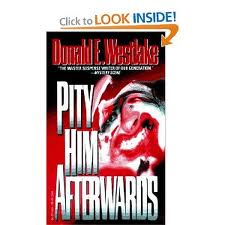
 ooks: Pity Him Afterward, Donald E. Westlake
Every once in awhile I get stoned just watching a literary master do his work. The last two nights I was flat out dazzled from beginning to end with Donald Westlake's 1964 novels PITY HIM AFTERWARD.
The story concerns an escaped madman who takes the identity of a man who is headed to a theater that does summer stock. While we see the story several times from the madman's point of view, we're never sure who he is. This is a fair clue mystery.
In quick succession, a young woman who works summer stock is found murdered in the house where the young, struggling actors stay. A part-time chief of police appears to find the killer.
Two points: writers owe their readers original takes on familiar tropes as often as possible. The madman here is no slobbering beast but rather a deranged and sometimes pitiful lunatic (the opening three thousand words are among the most accomplished Westlake pieces I've ever read). And the police chief Eric Songard is one of the most unique cops I've come across in mystery fiction. He works nine months of the year as a professor and summers as a police chief. The small town he oversees usually offers nothing worse than drunks and the occasional fight. Murder is another matter. Westake gives us a cop whose self-confidence is so bad all he can do is try and hasten the appearance of the regular cops from a nearby district. Meanwhile he has to pretend he knows what's going on. He could easily have gone to series. He's a great character.
As the story is told, we get a beleivable look at summer stock with its low pay, brutal hours, frequent rivalries. The payoff is that some of the actors will get their Equity card at the end of the nine week run and thereby become professional actors.
Then there is the telling. The craft is impeccable. Precise and concise and yet evocative because of the images Westlake constantly presents us. You also have to marvel at the rhythm of his language, watching how'll he'll shave an anticpated word here for a certain effect, add a word there for the sake of cadence. These sentences are CRAFTED.
There are so many great Westlake novels it's impossble to rank them. But given what he accomplished, I'd have to say this is one of his early best.
Ed Gorman is the author of Stranglehold coming out in October. You can find him here.
Forgotten B
 ooks: Pity Him Afterward, Donald E. Westlake
Every once in awhile I get stoned just watching a literary master do his work. The last two nights I was flat out dazzled from beginning to end with Donald Westlake's 1964 novels PITY HIM AFTERWARD.
The story concerns an escaped madman who takes the identity of a man who is headed to a theater that does summer stock. While we see the story several times from the madman's point of view, we're never sure who he is. This is a fair clue mystery.
In quick succession, a young woman who works summer stock is found murdered in the house where the young, struggling actors stay. A part-time chief of police appears to find the killer.
Two points: writers owe their readers original takes on familiar tropes as often as possible. The madman here is no slobbering beast but rather a deranged and sometimes pitiful lunatic (the opening three thousand words are among the most accomplished Westlake pieces I've ever read). And the police chief Eric Songard is one of the most unique cops I've come across in mystery fiction. He works nine months of the year as a professor and summers as a police chief. The small town he oversees usually offers nothing worse than drunks and the occasional fight. Murder is another matter. Westake gives us a cop whose self-confidence is so bad all he can do is try and hasten the appearance of the regular cops from a nearby district. Meanwhile he has to pretend he knows what's going on. He could easily have gone to series. He's a great character.
As the story is told, we get a beleivable look at summer stock with its low pay, brutal hours, frequent rivalries. The payoff is that some of the actors will get their Equity card at the end of the nine week run and thereby become professional actors.
Then there is the telling. The craft is impeccable. Precise and concise and yet evocative because of the images Westlake constantly presents us. You also have to marvel at the rhythm of his language, watching how'll he'll shave an anticpated word here for a certain effect, add a word there for the sake of cadence. These sentences are CRAFTED.
There are so many great Westlake novels it's impossble to rank them. But given what he accomplished, I'd have to say this is one of his early best.
Mike Wilkerson was raised in rural, northwest Kansas and has resided in St. Pete, FL for the last eight years. He is currently hard at work on his first novel, a crime saga based in St. Pete. To read more of Mike’s work, check out his loosely maintained blog, Writing the Hard Way.
IN COLD BLOOD. Truman Capote
Little men wh o live openly homosexual lives and speak with pronounced lisps do not bring to mind images of horrific crimes committed. And when the new guard talks crime writing, either true accounts or fiction, rarely is the name Truman Capote mentioned. Yet it most definitely should be. In Kansas, his seminal work In Cold Blood is required reading and remains a constant source of fascination for this writer.
Considered by many to be the original “nonfiction novel”, In Cold Blood puts you inside the minds of two killers: Richard “Dick” Hickock and Perry Smith; their victims in the Clutter family and the tireless KBI agent in charge of the investigation, Alvin Dewey.
Herb Clutter was a man of devout faith and ran a large, successful farm outside the small town of Holcomb in southwest Kansas, near Garden City. Widely respected throughout Finney County, Clutter was a dedicated family man of four children (the two younger children, daughter Nancy and son Kenyon were still living at home) and a loving husband of his clinically depressed wife, Bonnie. Though likely considered pious by today’s standards- he neither drank, used tobacco or swore- he was nonetheless liked by all of his employees and known to pay good wages.
In steep contradiction, Dick Hickock and Perry Smith met in the Kansas State Prison at Lansing, Kansas and held very little belief in either God or their fellow man. Hickock, a smooth talking pedophilic psychopath with a penchant for passing bad checks, heard about the Clutters from a former employee of the farmer who claimed Clutter kept ten thousand dollars in an office safe. Seeing an opportunity for the perfect score, Hickock found in Perry Smith, the troubled loner of mixed Irish and Cherokee ancestry, his ideal partner; a born killer.
On November 15th, 1959, following a whirlwind trip across the state, Hickock and Smith entered the Clutter home, robbed and then murdered the Clutter family with shotgun blasts to the head. Herb Clutter also had his throat cut beforehand. Their take: a diminutive amount of cash and a small radio. The response: a rural community gripped in the jaws of fear and speculation.
Although he originally claimed Hickock murdered Nancy and Bonnie Clutter, Perry Smith later recanted and admitted to committing all four murders in attempt to save Hickok’s mother despair (although Hickock is who proclaimed no witnesses would be left). Most chilling was Smith’s description of murdering Herb Clutter:
"I didn't want to harm the man. I thought he was a very nice gentleman. Soft spoken. I thought so right up to the moment I cut his throat.”
In Cold Blood is a psychological roller coaster of the criminal mind. Capote delves into the pasts of Hickock and Smith revealing men, especially in the case of Perry Smith, whose lives were short-circuited from the very beginning. The true brilliance, however, is the ability of Capote in seamlessly weaving together the lives of the Clutter family, Hickock, Smith and Alvin Dewey without once causing the story to feel tedious. And although you know who committed the murders and their ultimate end, you never stop wondering about what will happen next.
Whether you are a casual reader of literature or a crime fiction aficionado, In Cold Blood is a book which should be read, savored and for writers, studied. And most of all, like it’s extravagant author, never forgotten.
Mike Dennis can be found here.
Kiss Tomorrow Goodbye, Horace McCoy
Where do you begin with a novel like Kiss Tomorrow Goodbye? Horace McCoy’s 1948 noir journey through an unusual criminal mind is at once spellbinding and aggravating.
Spellbinding because it’s an intense, hard look at a very different kind of criminal, and because it’s suppose dly the granddaddy of all first-person-criminal novels, eventually bringing Jim Thompson face to face with his own hellish visions.
Aggravating because it’s not as easy a read as one might wish. You’re in for a slog through long, forbidding paragraphs and lots and lots of casual, throwaway conversation among the characters.
But beyond all this, the meat of the novel is as noir as it gets.
Paul Murphy, aka Ralph Cotter, is incarcerated on a prison farm, picking cantaloupes. The first two paragraphs, which take up the first two pages, deal with the overpowering odor in the barracks of “seventy-two unwashed men” and how it triggers a sense memory from his long-ago youth. These memories, we soon learn, are always with him, and they’re troubling.
With the help of Holiday and Jinx, two confederates on the outside, Murphy escapes and the three of them make their way to an unnamed city. Holiday is the woman in Murphy’s life. She sees to his every need, and usually lounges around naked under an open bathrobe. Jinx is straight out of the Hollywood School for Sidekicks.
Anyway, before you can say “all points bulletin”, Murphy is completely set up in the new city. He has a place to live, money in his pocket, access to a car, and a few shady contacts. Pretty soon, he’s plotting another job, this one a supermarket robbery. It doesn’t come off smoothly, and this brings on a sequence of events that lead up to a very choppy ending.
The ending notwithstanding, the novel moves right along as we follow Murphy through his odyssey of newfound freedom. One of the stops he makes along the way is the company of a bewitching beauty, Margaret Dobson. You just know that his involvement with her will come to no good.
What makes Murphy unique is that he’s a highly educated criminal. He’s a Phi Beta Kappa, in fact, and he takes an extremely dim view of the average stickup man. For him, people like John Dillinger and Baby Face Nelson are beneath contempt, nothing more than mouth-breathing Neanderthals who happened to make a few lucky scores.
He also sees himself as far above the man on the street. There’s a telling passage in which he’s riding a bus, during which he observes that people who habitually ride buses are “cheap, common, appalling people, the kind a war, happily, destroys”.
Moreover, when he’s not slapping Holiday around or pissing off crooked cops, he’s tossing out words like propliopithecustian and integument and at least a half-dozen others just like them.
I told you it was a tough read.
Jeff Meyerson
Alvin Toffler, Future Shock (Random House, 1970)
The terms "future shock" and "information overload" are commonplace now, but in 1970 when T offler's book came out it had a pretty big impact. As Wikipedia puts it Toffler's shortest definition of future shock is a personal perception of "too much change in too short a period of time".
 offler's book came out it had a pretty big impact. As Wikipedia puts it Toffler's shortest definition of future shock is a personal perception of "too much change in too short a period of time".
Also Toffler argues that society is undergoing an enormous structural change, a revolution from an industrial society to a "super-industrial society". This change will overwhelm people, the accelerated rate of technological and social change leaving them disconnected and suffering from "shattering stress and disorientation."
I don't think any of us who had reached maturity (at least chronologically) by 1970 could argue that the changes since then have not been disorienting, to say the least. Just think in terms of popular culture - music going from records to tapes to CDs. The revolutions brought on by the advent of VCRs, DVDs, DVRs and especially hundreds of channels of television and the "24 hour news cycle" have arguably changed the world.
I worked at a job in the late 1960's where we often had to go down to the "computer room" where there was an enormous, room-sized "thing" turning out computer programs we needed to do our work. In the days where most people seem to have a personal computer the changes are amazing to behold. And please do not even get me started on cell phones.
As I remember it, Future Shock was also one of the first books whose mass market edition came out in six different colored covers, but I can't swear to this.
All in all it would be interesting to reread this book, which had a major impact on me at the time, and see how well Toffler did in predicting where we are now from where we were then.
Paul Brazill
Bill Crider
Scott Cupp
Martin Edwards
Glenn Harper
Randy Johnson
George Kelley
Thursday, February 21, 2013
Gary Clifton and Ryan Sayles; HOW I WROTE THIS STORY

Ryan Sayles: Getting published on All Due Respect was a big goal of mine. When I read the submissions guidelines, Chris Rhatigan was very clear about one thing: he publishes "fiction about people who are criminals..."
That got the gears turning.
Earlier in the year I read another
author's story which took place in a strip club. I always try to leave
comments on the stories I read, and this was no exception. I made some
comment about strippers working for formula and meth.
That also got the gears turning.
So I wrote a story called "Formula and
Meth." I wrote about a stripper who runs a scam on the clients she has,
and I tried to make it funny in tone but sad in reality. So, the third
person narration (in Rhatigan's words) just made fun of everyone. But,
the situation itself--especially Angelina, the lead stripper--was sad.
It was too bad. Single mom, having an elderly neighbor check on her kid
at night while she's at the club, addicted to meth, working for drugs
and baby food.
No one is decent here. The sliding scale
of humanity is near the bottom. No one is honest. No one has love.
Everyone uses everyone else and the end focuses all of that into what I
hope was a lingering feeling of that sad reality.
So grab the collection. Ignore me
blabbing about my story and know that every single one in here is solid
as a rock. I'm proud my drivel made the cut, because this thing is THE
anthology to have. Rhatigan proved he could do the crime fiction world a
favor with how he selected the stories. Get your hands on it.
Friday, September 12, 2008
Friday's Forgotten Books, September 12, 2008

D.Z. Allen is the editor of the flash fiction site, Muzzleflash and an editor for Out of the Gutter.
The Oblivion Society, Marcus Alexander Hart
I won’t call this a “forgotten” book. I’ll call it one that not many have had the fortune to find yet. So now that you’ve found it give The Oblivion Society a read!
The book is exactly what I like to read and exactly how I want my novels to read…fast, funny, a little quirky, but with a great voice, strong pacing, a touch of sentimentality, lots of action, and most of all memorable characters that you want to read about and get to know.
The Oblivion Society is one of those all too rare books that I didn’t want to put down. And when I did, I couldn’t wait to get back to it. Marcus Alexander Hart is a fun and exciting writer. You won’t be sorry with this one.
Let’s all hear it for the smaller presses willing to take a chance on books like this. Support them. Love them. They are a writer’s best friend. (Next to cigarettes and bourbon.)
Timothy Hallinan is the author of eight published novels, most recently two Bangkok thrillers featuring expat “rough travel” writer Poke Rafferty. A Nail Through the Heart and The Fourth Watcher, which received a starred review in Publishers Weekly, are published by William Morrow. Hallinan has just completed the third novel in the series, Misdirection. He divides his time equally between Los Angeles and Southeast Asia.
Timothy Hallinan, Christopher West Series
West Meets East
As someone who writes mystery/thrillers set in Asia, I keep an eye on the competition. And I'd be lying if I said that I greet with unreserved enthusiasm the publication of a novel by a writer who intends to take a bite out of what I think of, in my less generous moments, as my fictional territory.
So I'm in an awkward position when it comes to Christopher West. West's four novels about police inspector Wang, set in Beijing, are definitely competition – or they would be, if they were still in print and West had a new one coming out. But they're not, and he doesn't, and that's a terrible shame. West is a wonderful writer and he deserves a broad and appreciative audience.
The book that begins the series, Death of a Blue Lantern, is a great place to start. Attending a performance of the Beijing Opera, Wang takes his time leaving the theater, and on his way out he notices a patron who seems to be drunk or unconscious. He's not, of course; he'd dead, dispatched with a tidy knife wound to the back of the neck, destroying the medulla oblongata. The victim proves to be a “blue lantern,” or low-level Triad recruit, and Wang's investigation quickly leads him to the Triad's “Red Cudgel,” or enforcer – and his beautiful daughter, who sings in a foreigners-only nightclub atop one of Beijing's most expensive hotels.
The plot ultimately also involves an archaeological site where precious works of art are being stolen, and a broad and varied cast of characters, almost any of whom might be the person Inspector Wang seeks. It's a great plot, intricate and beautifully structured, but the two most beguiling things about the book (and the rest of the series) are the characters and the setting.
The characters, beginning with Wang himself are nuanced individuals, real people whose differences make them easy to keep track of despite the unfamiliarity of Chinese names, which can be difficult for Western readers to remember. There isn't a flat sketch in the bunch: they all seem much deeper than the printed page.
The setting is riveting, not just because it's China, but because it's China at a specific moment, poised at the opening movement, so to speak of Deng Xiaoping's Communism-shattering economic liberalization, but not far removed from the brutal crushing of the protesters at Tiananmen Square in 1989. Death of a Blue Lantern was written in 1994 and is probably set a year or two earlier. The Party, now widely ignored in China, still inspires (in the novel) a certain amount of dread; West's Beijing is full of people who have come from the countryside, but they are just a trickle compared to the hordes – the largest human migration in history – who have trekked from village to city in the past five or six years. Private businesses have sprung up, but there is not yet the preoccupation with becoming rich, nor is there the vast gulf between the have-alls and the have-nothings that scars present-day China. Some of the book's action takes place in the alleys and hutongs of old Beijing, the vast majority of which have now been swept aside, thousands of them destroyed for the Olympics.
Inspector Wang is a good man who believes in justice, and who is caught up in a system that is changing so fast that it threatens much of what he and those around him believe in. Matters of life and death, guilt and innocence, are immutable, but in West's novel, those issues are confronted in a world where virtually nothing else seems to be permanent. The China in these books is on the brink of the most profound short-term transformation of any nation in history.
Read Death of a Red Lantern. Read everything by Christopher West. He hasn't published a novel (to my knowledge) since The Third Messiah in 2000. If enough of us order his books, maybe some publisher will see what a writer of Christopher West's talent could do with the China of today, the China we all watched, openmouthed, for fourteen days in August.
Christopher G. Moore is the author of the Vincent Calvino crime novel series. Two
novels in that series: The Risk of Infidelity Index /(2007) and Spirit
House (2008) are published by Grove/Atlantic Press. They will also
publish Paying Back Jack in 2009. website. www.cgmoore.com
Georges Simenon, Dirty Snow

Georges Simenon- Georges Simenon the Belgian writer, who died in 1989, authored 200 novels, 150 novellas, among other works and wrote under a couple of dozen pseudonyms. If one had counted all of Raymond Chandler’s books, and for the hell of it, added his bar bills to make another dozen books, Chandler’s output would still remain a small fraction of what Simenon produced. But Simenon’s work rarely features in the discussion of modern fiction. Simenon, the man, is often thought of as a legendary lover. To have one’s fiction largely forgotten and one’s sex adventures remembered is one of those roll of the dice outcomes. In Simenon’s case, the number of conquest he notched up with a sniper’s methodical record keeping vastly out numbered his books.
Simenon’s most famous series beginning in 1931 and ending in 1972 ran for 75 novels; the series featured the French police detective, Inspector Julies Maigret. Simenon also wrote literary novels. Dirty Snow falls in that category and is set in an unnamed country during the occupation by an enemy force. It is most likely drawn on Simenon’s experience of living in France during the Nazi occupation. (Simenon was accused of being a German collaborator during WWII and banned from writing for five years after the war ended.) The lead character named Frank, a nineteen year old, has killed his first man, ambushing him at night, sticking a knife in his ribs and stealing his service revolver. Frank lives with his mother who runs a brothel from her apartment in a building where the inhabitants are hostile to the occupiers and to Frank and his mother, who they suspect are collaborators. Given the soldiers and police who rule with an iron-fist in the occupation are the paying customers at the brothel, their suspicions about Frank and his mother ring true.
Dirty Snow is a chilling example of noir fiction. Those in the black market seize their opportunities, do business with the enemy, enrich themselves with shady deals and murder, and soon act as if they are invincible. The dance between the Occupation authorities and Frank and his friends slowly reveals that behind the curtain of collaboration no one remains untainted or safe; that while fear corrodes the morale of many, leaving an exhausted few to draw upon the strength to resist the occupiers. As a story of occupation, terror, hubris, secrecy and how power causes people to lose their perspective, their sense of humanity and ultimately their life.
Dirty Snow answers the debate between what is noir and what is hardboiled fiction.
Nothing is fiction rolls us through gutter of alienation, throws dirt in our vision of pure white snow as this example of noir writing. Simenon reminds us, that in noir, there is no escape from the darkness of our doomed destiny.
Some of this information comes from Wilkipedia.
.
Dan Wickett is the man behind Emerging Writer's Network, and editor of Visiting
 Hours and Dzanc Press
The Blind Pig by Jon A. Jackson
Originally published in 1978, I stumbled upon this book about a decade later, when it was in a trade paperback with a cartoonish styled cover. It had a rave blurb on the cover from James Crumley, who I'd also recently discovered, and had a Detroit setting. As I'd recently been reading Estleman's Amos Walker novels and Kantner's Ben Perkins mysteries, finding another author with a series set in Detroit seemed about right.
I recall opening the book and reading the first page, in which Seargent "Fang" Mulheisen drops a racial slur about a suspect to his African-American partner, and quickly follows with "No offense." There was something about the way he included this so casually that made the story seem a little more real to me - not sheltered.
The book, and at least the first four or five books in the Mulheisen series were well-written, fast-paced, hilariously funny novels. This one, delving into the world of after hour Blind Pigs and jazz joints in Detroit remains my favorite of the bunch though.
More Friday Forgotten Books (and they will appear during the day). Let's cross our fingers for those in Texas).
Dave Zeltserman
C.T. Henry
James Reasoner
Tony Black
Randy Johnson
Amy Myers
Ed Gorman
Lesa Holstine
Kerrie Smith
Bill Crider
A.N Smith
David Cranmer
Paul Bishop
Scott Parker
August West
Joe Boland
Jay
Medora
Thursday, September 26, 2013
Flash Fiction Day" ----Man's Tastes Gets Him Into Trouble.

THESE ARE THE STORIES THAT TURNED UP BY 9:AM.
RIDERWOOD
MAN’S TASTES GET HIM INTO TROUBLE
A.J. Wright
The trains never stop in Riderwood
anymore. Truth be told, no more trains even pass through here, either. I miss
the trains and their warning whistles that started when they were about a mile
out from the tiny station. The telegraph office where I worked was a lonely place
most of the day and night, so the trains provided welcome distraction from my
usual activities, reading and trying to write dime novels. Now and then,
sometimes several times in one day, a citizen would actually come by to send or
pick up messages. The favorite topic seemed to be someone’s death.
One thing
the trains always brought me was a new supply of reading material. I had no
particular interest in the newspapers, although I read even those when
desperate. The wanted circulars were interesting, a constant parade of robbers
and murderers. The best items though were the dime novels. I got lost for hours
in the exploits of heroes like Nick Carter or Buffalo Bill and the outlaw tales
about the James Brothers or Rube Burrow.
Another
regular arrival on the Wednesday train besides the mail was a gentleman whose
name I eventually learned was Mr. White. I never believed that name was real,
but I did believe he was a gentleman even though he never dressed like one. He
always arrived in the worn and dusty clothes of a hobo like the ones who
sometimes waved from the cracked door of a freight car as the train began to
leave the station. Those men never left the cars; Riderwood was too small for
them. But not for Mr. White.
One Wednesday evening per month as
the 9 o’clock train slowed to an eventual stop, I could see him jump down from
one of the cars back near the caboose and disappear down the short alley between
the drug store and the bank. The train crew never seemed to notice him, or at
least never responded to his presence. Each time he walked with purpose and
unlike any bum I’d ever seen.
For months
the pattern was the same. He would arrive, and I would watch him disappear. On the
following Thursday night, as the train was slowing for its stop, I would see
him pop out from between the two buildings and climb aboard a freight car with
an open door. In between these events I would continue to man the telegraph
office, send and receive occasional messages, and read my dime novels. I kept
them under the counter in my office; if I ran out of new ones before the next
delivery, I read some favorites again.
After a
while I began to wonder what Mr. White was doing in town for one 24-hour period
every month. I decided that the next
time he arrived I’d follow him and see what was happening. Two weeks later I
had my chance. A little after nine o’clock the train pulled into the station; and
Mr. White jumped down from his car and headed into the alleyway. I had already
closed up the telegraph office and quickly followed him as he walked away from
the station.
We were the
only two people on the street as he headed across Main and down Walnut Avenue.
He never slowed or looked back, but I stayed as far behind him as I could
anyway. After only a few minutes I knew where he was heading—a two-story house
on Walnut that belonged to a travelling salesman named Walter Richards. He must
have been out of town because Annie Richards opened the door just as Mr. White
reached the top of the porch stairs.
Thus began a
new phase in my knowledge about Mr. White. I knew now why Mrs. Richards came to
the telegraph office once a month, always on a Tuesday, to send what I thought
was an innocent message to a Mr. White in the city. Her husband Walter was out of town much of
the time; I frequently saw his comings and goings as I worked the telegraph
office. Mr. White and his Riderwood lover must have decided that once-a-month
meetings were all they should risk in our small town.
That first
time I watched from across the street as she let him inside and quickly closed
the front door. I saw their shadows merge against a pulled window shade as they
briefly embraced and then disappeared, no doubt heading up the stairs to a
bedroom. I could imagine Mr. White carrying Annie in his arms and then watching
her undress as he removed his own clothes. Over the next few months I imagined
a lot of things going on between them. The heroes and villains of my dime
novels no longer seemed quite as vivid or appealing.
From time to time I suspected that Mr. White
knew he was being followed from the station, but he never confronted me. I saw
Mrs. Richards around town as often as before, and she was as nice and pleasant
to me as ever. I thought of myself as the great protector of their secret; she
had to be happier with Mr. White than with her husband, right? Otherwise, what
was the point?
Then one
night the whole thing fell apart. I had followed Mr. White as usual and stood
across the street after he had gone inside the house. I usually remained there
for an hour or so, imagining, hoping for a glimpse of something. I was about to
turn and go when I felt a large hand grip my left shoulder with a force that
quickly began to hurt.
“What’s
going on here, boy?” I heard Walter Richards ask in a louder than normal voice.
Before I could answer, he said, “I think I know.” I watched him in helpless
fear as he walked to the front door. Finding it locked, he quickly kicked it
open. By that time I had turned to run back toward the telegraph office, but I
could still hear the trio of shots fired inside the second story of the house.
I never saw
Mr. White again. I heard later that a man dressed as a hobo had jumped to his
death that night up the line from Riderwood. He turned out to be a wealthy
lawyer from the city. In a few days they buried Mr. and Mrs. Richards in the
town cemetery. I remained working for a long time at the telegraph office, reading
dime novels and imagining things.

SEATTLE MAN'S TASTES GET HIM INTO TROUBLE
By Gabe Bosworth
"The filet was far too tough for my taste. On several occasions I paused to ensure all dental work was still intact," Mr. Mantini read aloud from the food section of The Seattle Times.
Julian, sitting before him a little cowed, still took a moment in the recitation to savor the bite of his own prose.
"The paté was gritty and of an alarming color; certainly more gruesome than toothsome, and perhaps the lowest of the many low points an evening at Mantini's Chophouse & Grill promises" read Mr. Mantini, jumping ahead to his favorite passage. He had affected his best effort toward a royal British accent.
Julian began to recite: "Mr. Mantini, while I can see that this was not the review you were expecting, I would also hope you can appreciate the invaluable service I have provided by offering a forthright outsider's assessment of the fare here - ” Mantini held a beefy paw in the air for silence and got it.
“Jim Gleason was supposed to write this review. I spoke to Jimmy personally last week. We decided he loved the paté Couldn’t get enough of it.”
“Jim got laid off,” Julian said with an understudy’s practiced remorse. “The Times may be the only daily left in town, but it’s still a newspaper.”
“That’s a tough business” Mantini agreed.
“As is that of a restaurateur ,” Julian said, “but with a capable consultant on board, there is real potential here. I’ve taken the liberty.” He placed an expertly bound resumé between them. “My hourly is on the back page. It may be a little more than you had to advance Jim Gleason, but I bring more to the table" - here he patted the tabletop so that his pun would not go unnoticed - "than just a favorable review; I understand your foremost charge here is providing a singular gastronomical experience for your patrons.”
"My foremost charge here," said Mantini, leaning forward with a phlegmy stage whisper that filled the empty dining room, "is collecting every dollar from every girl I have walking on a street or dancing on a stage from Columbian Way to the north end of 99, and running them promptly, cleanly, and--above all--taxably through tickets in this cafeteria. A practice, by the way, that won't pass two fucking annual audits when we are printing up checks to a dining room that has been emptied by hatchet jobs like this." Mantini rattled the newspaper over his wide belly. He was no longer whispering.
Julian was turning a milky white around the brow and collar.
"You seem to have made it your foremost charge to provide an exceptional gastronomical experience for my patrons." Mantini paused just long enough for his bile to lower. "And, as a successful business owner, I always reward ambition with opportunity."
Two large men were already standing behind Julian. He twitched into himself like a cornered animal.
"I should mention," Julian lied, addressing primarily the exit, "that I have sold a similar review to the Seattle Weekly and, with my in-person recommendation of course, I could see that certain details be added, others...trimmed?"
"Steve and Kev will show you what we'd like cut," said Mantini.
***
"Far too tough for my taste," said Steve. His voice echoed in the nighttime emptiness of the kitchen. There was a pop and some wet tearing sounds.
"More gruesome than toothsome," Kev said in Mantini's singular British accent. He underhanded a glistening purple lump into a stainless steel organ grinder with the other offal. They looked at each other for a moment and then just about lost it, finally trading loud giggling shushes before getting back to work.
Michigan Man’s Tastes
Get Him Into Trouble
by Patti Abbott
 Daniel was not a gastronome at birth, but it wasn’t long
before the word was applicable. Stories detailing incidents of his superior
palate as a toddler were numerous. He learned his skills at the side of the finest
cook he’d ever met—his mother.
Daniel was not a gastronome at birth, but it wasn’t long
before the word was applicable. Stories detailing incidents of his superior
palate as a toddler were numerous. He learned his skills at the side of the finest
cook he’d ever met—his mother.
“Too much rosemary?” she’d ask him before serving the
holiday dinner.
The aroma of roasted poultry was intoxicating to her young son, even if the chicken was a tad over-infused with garlic. She held the fork out, having stolen the smallest tidbit from the underside of a breast.
The aroma of roasted poultry was intoxicating to her young son, even if the chicken was a tad over-infused with garlic. She held the fork out, having stolen the smallest tidbit from the underside of a breast.
“More lemon. And a pinch more marjoram.”
“Brilliant,” she said, after tasting it.
Daniel’s early reading matter was the work of James Beard, and by twelve, he’d successfully replicated Beards’ recipes. He taught himself French to study the work of Escoffier, the author of Le Guide Culinaire, and inventor of the five mother sauces. Daniel aspired to the title bestowed on his mentor: roi des cuisiners et cuisinier des rois.(king of the chefs and chef of the kings).
This was unlikely however since he rarely cooked for anyone other than himself.
Eventually Daniel came on the idea of using the finest
ingredients available to create an contemporary version of the five sauces. Quelle
drole to confine oneself to ingredients as prosaic as butter, garlic and
cheese. He would turn Escoffier’s codification on its ear.
The first four sauces were unparalleled successes. His fruit
sauce featured Dansuke watermelons and Yubari cantaloupes, the world’s most expensive
melons. A curry was composed of Devon crab, Beluga caviar, Scottish lobster,
and quail eggs. A topping composed of caviar and goji berries made his eyes
roll with pleasure, and his penultimate sauce, a dessert concoction, used 28
different imported cocoas, some formulated personally for him by chocolatiers.
His final sauce would use white truffles, available only a
few months each year. The best were found in Italy, and especially in
Alba. Traditionally the truffles had been ferreted out by pigs that,
mysteriously, had the nose for it. But pigs also had the inclination to gobble
down the white gold, sometimes destroying the entire yield. So pigs had mostly
been replaced by dogs that were satisfied to feast on pedestrian treats rather
than the truffles.
“I should like to go along,” Daniel told the importer at the
Eastern Market in Detroit.
“To the airport to pick up your shipment?”
“To Roccafluvione.”
This was the town in the Le Marche region his supplier identified as a viable source.
This was the town in the Le Marche region his supplier identified as a viable source.
“You mean to the marketplace there?”
Daniel drew an impatient breath. “No. I want to hunt them myself. I should like to smell the earth, to inhale the scent I’ve read about since childhood.” He paused. “And I want to hunt with pigs rather than the dogs. I have a preference for traditional methods.”
He’d waited a long time for this day and he’d be damned it some mutt was going to tarnish the image of striding amidst the oak trees, pig in hand.
“It’s mostly forbidden,” said his importer. “You’ll have to
make special arrangements.”
“I’m prepared to do whatever it takes.”
Daniel opened his wallet. And eventually his bank account.
Daniel opened his wallet. And eventually his bank account.
And so it was on a dark October day that Daniel and his guide, Bruno, and the Marco, the pig, set out into the hills.
“No one knows you are here?”
Daniel shook his head.
“You must never speak of this excursion to anyone. Normally I’d ask
you to wear a blindfold,” his guide said in excellent English. “But I doubt you
will make a second trip.”
“No,” Daniel agreed. “This will be my only outing.
Truthfully I am not fond of fungi. They tend to disagree with me, in fact.” His
stomach was already rumbling.
“Then why this trip? We have perfected the shipment of
truffles, you know.”
Daniel explained his lifelong desire to hunt for the truffles
that would complete his final sauce.
The man nodded knowingly. “I detest red wine. Yet I always drink a glass or two at my local tavern. The owner makes a point of giving me the best red wine in the house because of my profession,” he said, waving his arm around. “I know it’s good, but I’d much prefer beer.”
The pig, trudged on, only
occasionally giving a half-hearted snort. He was very large and far uglier than
Daniel had imagined.
“You will know you are amongst the truffles when we arrive. It will remind you of locker rooms back in school. Feet, sweat, testosterone, earth.” Bruno drew a breath and his chest expanded. “Marco has the area’s finest sense of smell. Much better than those damned dogs.”
Daniel smiled.
“So you’re going to eat only enough to see that this sauce is up to snuff, and then never touch them again,” Bruno said, after a while.
“That’s about the size of it,” Daniel said. “Just enough to ascertain I have met my objective.”
The oak trees towered above them, the forest growing denser as they walked. At last, Bruno glanced at Daniel, indicating with his eyes that the rope had been tugged by the eager pig. Using the stout stick, he made Marco back away. The three of them stopped. A nice stand of oaks towered over a pirate’s bounty of the white gold.
The odor was overpowering, and Daniel suddenly felt light-headed. Perhaps it was not just eating fungi that made him ill: it could also be the smell. Without warning, he plunged headlong into the swell of truffles.
The pig, angry at this unexpected blanketing of his greatest joy, jerked loose of the rope, immediately gobbling away at both Daniel and the truffles. Within seconds, a piece of Daniel and a piece of the white truffles co-mingled. A piece of leg, a piece of thigh. And so it went.
Bruno stood dumbfounded, trying to decide what to do. There was little choice, he thought, looking at the earth beneath him. Knowing the trouble this affair would cause, he and his pig, beaten hard with a stick, ran all the way home.
Fleur Bradley, MISSISSIPPI MAN'S TASTES GET HIM INTO TROUBLE
Sandra Seamans, HOW HUNGRY
Evan Lewis. SKYLER HOBBS AND THE TROUBLESOME TASTE
Dana King, PENNSYLVANIA MAN'S TASTES GETS HIM INTO TROUBLE
Loren Eaton, SUGAR AND SPICE
Ken Leonard, BOSTON MAN'S TASTES GET HIM INTO TROUBLE
J.F. Norris A TASTE OF TEMPTATION
Bob, The Wordless, CLEVELAND MAN' S TASTES GETS HIM INTO TROUBLE
Subscribe to:
Posts (Atom)